
Background
Margaret Burchett, known to many as Meg, was born on 22 August 1934 in Greenwich, a suburb of Sydney. She attended Greenwich Primary School and later, opportunity classes at Artarmon Primary, going on to the selective North Sydney Girls High School. She obtained a Teachers’ College scholarship to the University of Sydney where she majored in Botany and went on to complete her PhD, with ground-breaking research in plant physiology – that of the mechanism of sugar transport and other substances in plants.
After her graduation Meg taught at several high schools and was a university tutor before she joined NSWIT, the then NSW Institute of Technology, in 1970 as a Lecturer at the School of Life Science, in the Faculty of Science. In 1972 she was promoted to a Senior Lecturer and the Head of Biology Education Unit, and then the Director of General Studies. In 1986 she became an Associate Professor and, over the next decade held the position of the Head of a Department of Environmental Sciences as well as various leadership positions within the Faculty of Science, including deanship.
When, in 1988 NSWIT became the University of Technology, Sydney (UTS), Meg was appointed by the minister as the foundation member of the UTS Council and was the Head of the School of Biological and Biomedical Sciences for a term of 3 years.
Meg retired at the end of 1994 from full-time work and UTS awarded her an Honorary Doctorate for her services to science education. She spent the next 24 years as an Adjunct Professor continuing to contribute to UTS research, academic programs and student supervision on a part-time basis.
During her almost 50 years at UTS Meg was a visionary and a trail blazer - she initiated and promoted many new directions in teaching and research in which environmental sciences at UTS became a leader. She could see opportunities for transdisciplinary collaboration in science education and research both within and outside the University. For example, in 1984, she spearheaded the developments of an innovative curriculum for nurse education in UTS, the first of its kind; in late 1980s, she developed an innovative course in Urban Horticulture that allowed an articulated entry from NSW TAFE to UTS; and in 1990s, she initiated the establishment of a transdisciplinary Institute of Coastal Resource Management that engaged in research and postgraduate training through collaboration among the Faculties of Science, Engineering and Business.
Role in Australian ecotoxicology
One of Meg’s lasting achievements that had a long-term impact on environmental science in Australia was her pivotal role in the establishment of the Centre for Environmental Toxicology (CET). She foresaw the important role that Australian science could play in the emerging field of environmental toxicology / ecotoxicology and, in 1984, collaborated with Dr David Leece from SPCC (State Pollution Control Commission, later to become NSW EPA) to establish the Centre at NSWIT. This was the first such joint venture in Australia with NSWIT providing a specialised laboratory space at the Gore Hill campus for the scientific staff of SPCC.
Initially the Centre’s work focussed on developing ecotoxicity testing to provide data directly applicable to Australian biota tested under Australian conditions that would underpin both Commonwealth and NSW legislation on hazardous chemicals; previously such data was sourced from overseas. The Centre’s work expanded into developing new test methods, ecosystem studies, bioaccumulation and risk assessment. It encouraged collaborative research in ecotoxicology among government scientists, NSWIT/UTS academics and the wider scientific community.
The collaborative activities of CET provided a nucleus for the newly emerging ecotoxicological community in Australia and New Zealand. In July 1994 the Australasian Society for Ecotoxicology (ASE) was formed, again through the efforts of Meg and Dr David Leece and a group of Australian and New Zealand ecotoxicologists that included Dr Graeme Batley, Dr Des Connell and Dr Chris Hickey. Meg was the inaugural President of the Society which, is now a part of SETAC Asia-Pacific. Meg, together with Dr David Leece, was one of the first honorary life members of ASE and this honour remained current with the transition to SETAC. The Centre existed for 17 years until 2003 when the UTS Gore Hill campus was moved to Broadway, but the collaborative links with environmental scientists at UTS remained strong to this day.
Meg continued to be a strong supporter of Australian ecotoxicology – she regularly attended the many ASE conferences, chaired sessions, presented papers, both in Australia and overseas. She also contributed to the Society’s Australasian Journal of Ecotoxicology, first published in 1995, which provided opportunities for ecotoxicologists to publish Australian research.
Ecotoxicology education
As the occasional Co-Director of the Centre, Meg initiated and promoted the development of new postgraduate courses in ecotoxicology, initially with coursework degrees and then, when UTS became a university, by offering research degrees with contributions from all members of the Centre. Thus, the joint Centre was the first to train Australian ecotoxicologists. It was Meg’s deep understanding of the industry that ensured that the courses were available for part-time as well as full-time study, with the ‘Russian doll’ pattern of interlinking Graduate Certificates, Diplomas and Masters degrees.
Inevitably, the postgraduate teaching influenced UTS undergraduate programs and in 2004 Meg strongly supported the introduction of Bachelor of Science in Environmental Forensics, which included a major strain of ecotoxicology and which, more recently, morphed into the current Bachelor of Sustainability & Environment focussing on the ecosystem protection and management.
Meg’s educational legacy at the CET continued into this century with the development of short courses for contaminated site professionals, the Contaminated Site Assessment, Remediation and Management (CSARM) courses, which started in 2009 and continue to this day. Meg took the lead to develop the program at the request of NSW EPA such that it involved contribution from the industry and NSW EPA. And she continued to contribute to the courses for many years as Adjunct Professor.
Research
As plant scientist, Meg’s research always focused on current environmental problems, specifically, the effect of pollution on plant communities and plant responses to toxic chemicals. She examined the applicability of the OECD protocol for toxicity testing of soil-borne contaminants to standard plant test species and to Australian plants under glasshouse and field conditions. Subsequently, in modifying the protocol to test the toxicity of contaminated soils, Meg was able to provide advice on remediation to the contaminated site professionals. Her work extended to investigations of the potential of native Australian species to remediate derelict mine sites.
In another series of projects, Meg, with colleagues and postgraduate students, studied the effect of pollution on estuarine plant communities, specifically mangroves and saltmarsh. These projects applied the triad approach (ie chemistry, ecology and toxicity) to examine responses of estuarine plant communities to metal contamination in the sediments. This field and laboratory research contributed to the decisions made for the restoration of estuarine ecosystems at the Sydney Olympic Site. There were numerous research outputs including a retrospective evaluation of Ecological Risk Assessment measures at the site.
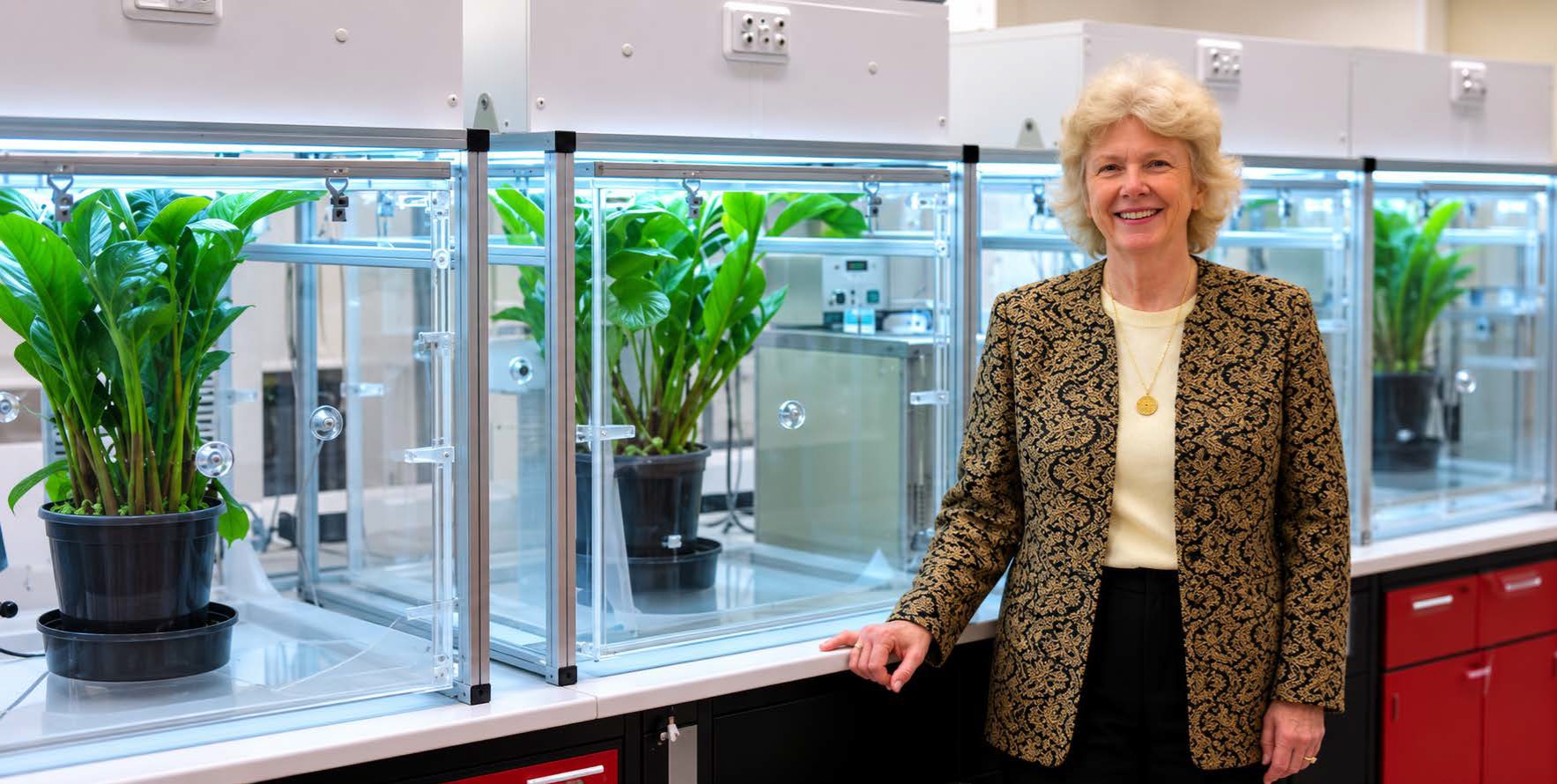
In 1990’s Meg consolidated her research interests in ecotoxicology and horticulture by examining the potential of urban plants as potential biomonitors of air pollution. The initial project, in collaboration with NSW EPA, identified several molecular indicators of air pollution in urban street trees. This line of research led Meg to studies of the role of indoor plants in ameliorating indoor air quality. As the research expanded, Meg, already an Adjunct Professor, formed a Plants and Environmental Quality Research Group which continues to publish prolifically and has gained international reputation in this field. Meg remained the lead investigator until 2012 when she stepped down, but she continued to contribute strongly until 2018.
Lasting contribution
Meg’s lasting successes in such collaborative and innovative projects were due to her natural collegiality and lack of self-importance as well as her organisational and communication talents. She was refreshingly candid and non-threatening. She always saw the positives of any project for the reputation of the organisation. Thus, she was able to attract many academics and non-academics to join and contribute to the projects she promoted.
Meg was highly respected by the greater scientific community through her long association with many external organisations that had supported research and course development. In addition to the continued collaboration over the years with NSW EPA in its various forms, Meg had been a member of NSW Nursery Industry Association, a one-time President of Australian Institute of Horticulture and closely associated with the Interior Plantscape Association. She was a member of the Board of Trustees of Royal Botanic Gardens, of the Expert Environmental Panel of the Australian Heritage Commission, the university representative on the Site Auditor Accreditation Panel under Contaminated Land Management Act, and a UTS representative on the Australian Marine Sciences Consortium. She was also a university representative member of the Homebush Bay Environmental Reference Group, HBERG, and on the Board of Studies of NSW Department of Technical and Further Education, as well as a Member of Science Curriculum Committee at NSW Board of Senior School Studies and a Chair of its Biology Sub-Committee.
Meg was a talented and much-loved teacher – many ex-students recall her infectious enthusiasm for science and the positive influence she had on their scientific careers. She was a mentor and a role model for many. She was also greatly loved and respected by all –her staff, her colleagues and the greater scientific community. She was hard working, and led, by example, with a soft touch, always drawing out the best in people. She had grace, humility, enthusiasm and sense of humour. Meg leaves many with the memory of a wonderful human being with whom it was a pleasure to work and socialise. This was so evident in the crowded funeral chapel on 16th June 2026 attended by many of her ex-students, past colleagues and family.
I acknowledge using information from Dr John Chapman and Dr Munro Mortimer in writing this; and Therese Manning for her critical reading of the final version.